Published: 20 July 2026 - 07:00 WIB - Views: 0 views
[unsoed.ac.id, Mon, 20/7/2026] Universitas Jenderal Soedirman (Unsoed), through its Biodiversity and Maritime Center under the Institute for Research and Community Service (LPPM), is supporting the pilot implementation of the Smart Dropbox as an innovation for managing coastal plastic waste at Menganti Beach, Menganti Village, Kesugihan District, Cilacap Regency, on Friday (July 17, 2026). This program is part of the Smart Incentive Scheme, which encourages communities to adopt the 3R principles (reduce, reuse, recycle) while also generating economic benefits from collected plastic waste.
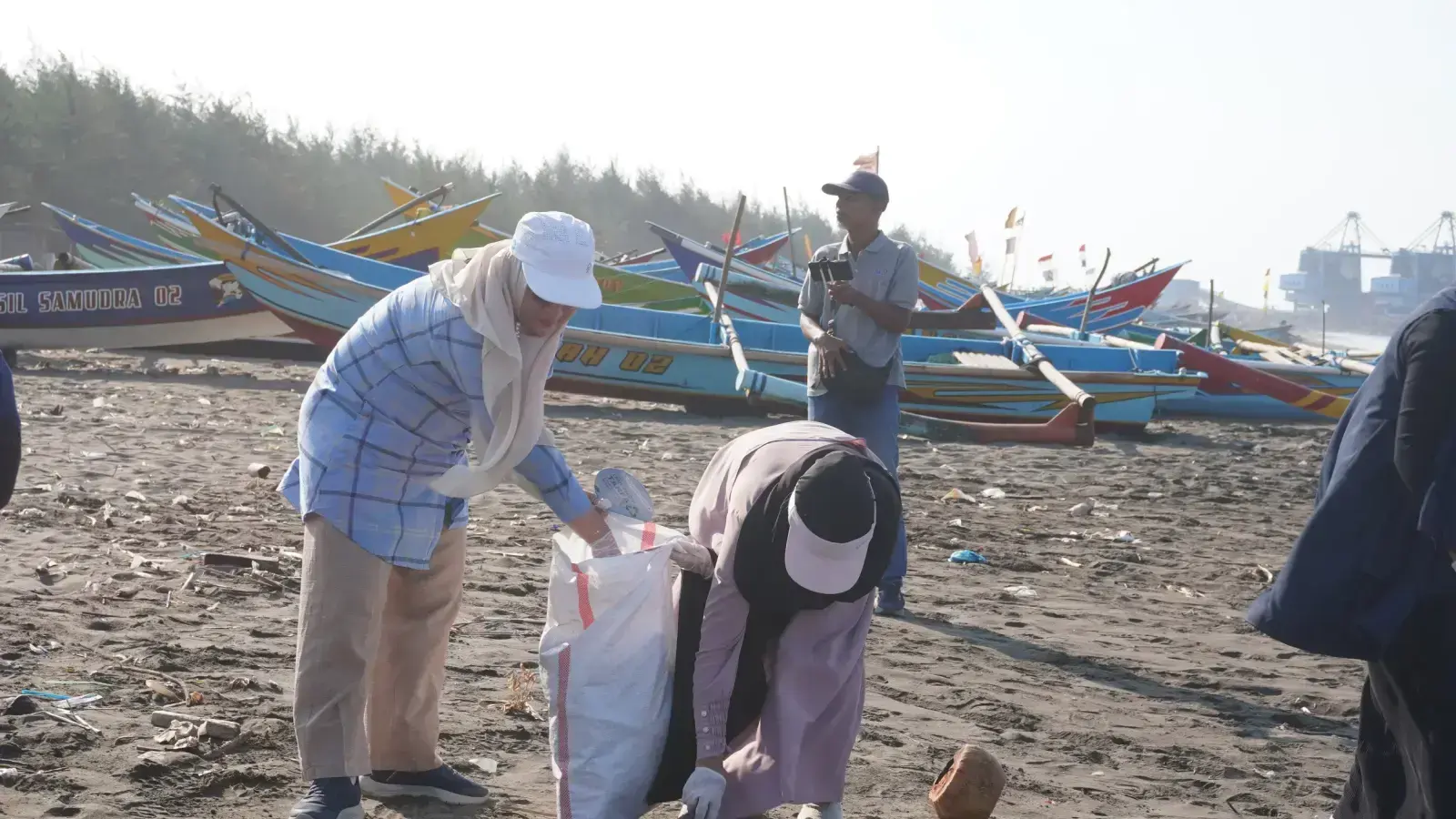
The activity, organized by SNV Indonesia through the SOLUSI Project (Integrated Land and Seascape Solutions for Indonesia) in collaboration with the Cilacap Regency Government, began with a beach clean-up campaign, followed by the inauguration of the Smart Dropbox as a facility for collecting plastic waste in coastal areas. In addition to Menganti Beach, a similar facility has also been installed in Bunton, Adipala District.
Unsoed was represented by Dr. rer. nat. Riyanti, S.T., M.Biotech., and Firda Haifa Fadhilah, S.T., M.T. Their presence underscores Unsoed’s commitment as an academic partner in supporting environmental education, research, community assistance, and multi-stakeholder collaboration to reduce plastic leakage into the ocean.
Dr. Riyanti emphasized that addressing plastic waste in coastal areas requires an integrated approach, from education to data-based evaluation. “Universities can contribute through the provision of data and scientific studies, public education, technical assistance, and evaluation of behavioral changes and environmental conditions. In this way, the Smart Dropbox is not merely a waste collection point, but part of a knowledge-based coastal management system,” she explained.
Similarly, Firda Haifa Fadhilah highlighted the importance of continuity between infrastructure provision, data management, and community involvement. Proper record-keeping is essential to track the volume and types of collected plastic waste, the frequency of deposits, the level of community participation, and the benefits generated from the Smart Incentive Scheme.
Project Manager of SOLUSI–IKI–SNV, Audrie J. Siahainenia, Ph.D., explained that the Smart Dropbox is part of an incentive-based approach that connects communities, government, waste banks, the private sector, and universities in building a sustainable waste management system.
“This program not only introduces the Smart Dropbox, but also includes digital recording systems for waste banks, dashboard development, educational materials, strengthening corporate social responsibility forums, and schemes to convert plastic waste into economic benefits,” she stated.
Through this mechanism, plastic waste deposited by the community is weighed, recorded, and distributed to waste banks for recycling. The value of the collected waste can then be converted into various benefits, including support for fishermen’s operational needs, thereby encouraging community participation in maintaining coastal cleanliness.
In addition to lecturers, Unsoed Marine Science students also participated in the beach clean-up as part of experiential learning. This activity is expected to strengthen synergy among government, academics, communities, the private sector, and the public in achieving sustainable coastal waste management.
Through this collaboration, the Biodiversity and Maritime Center of LPPM Unsoed reaffirms its commitment to supporting the sustainability of the program through research, environmental education, community engagement, innovation development, and data-driven monitoring to reduce plastic pollution in coastal and marine areas.